
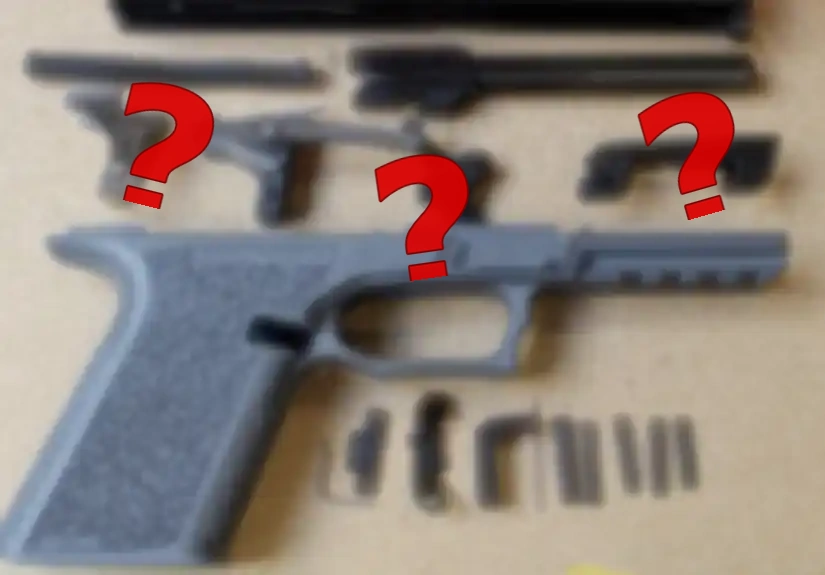
Ghost guns and Glock switches now appear often in local and national news. Both raise real concerns. A switch can illegally convert a semiautomatic pistol to automatic fire. Criminals can also misuse privately made firearms, just as they misuse factory-made guns.
Those facts matter. However, they do not excuse exaggerated or misleading claims.
Too much coverage combines 3D-printed frames, complete firearms, unserialized guns, illegal switches, ordinary Glock pistols, and theoretical firing rates into one frightening story. This approach removes important context. It also makes lawful firearms and their owners part of the threat.
Lawful gun owners do not need to defend switches to question that reporting. We can oppose criminal misuse while still asking journalists and officials to explain the facts accurately.
Ghost Guns Cannot Simply Be Downloaded
News reports often claim that criminals can download and print ghost guns.
What they can download is a digital file.
Depending on the design, that file may let someone print a frame or receiver. Doing so still requires suitable equipment, materials, knowledge, and time. More importantly, a complete and working handgun does not simply emerge from a desktop printer.
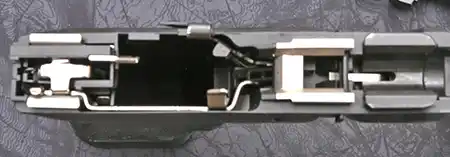
A typical Glock-pattern pistol built around a printed frame still needs a slide, barrel, recoil assembly, trigger parts, locking block, rails, sights, pins, springs, and a magazine. Most of those parts must handle heat, pressure, friction, and repeated impact. They are usually conventional metal components that someone must manufacture or purchase separately.
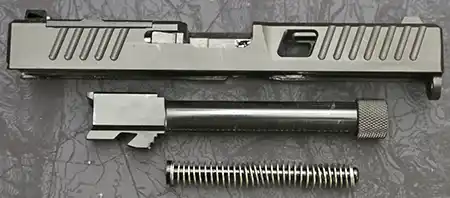
None of this means that a person cannot build a privately made firearm. It means that calling a complete gun “downloadable” skips most of the process.
A person can download plans for a house. That does not mean the person downloaded a house.
The wording matters. Saying that someone can download a gun suggests that almost anyone can click a link, press a button, and receive a working firearm a few hours later. In reality, the process requires many more steps and parts.
The Term “Ghost Guns” Covers Several Categories
The label ghost guns can describe several types of firearms.
It may refer to a gun assembled from a frame or receiver that was incomplete when sold. The term may also describe a firearm built from a commercial parts kit. In other cases, it refers to a gun with a 3D-printed frame or another printed part. Sometimes it simply means a privately made firearm without a serial number from a licensed manufacturer.
Those categories overlap, but they are not identical.
A firearm assembled from an unfinished receiver is not automatically 3D printed. A gun with a printed frame is not completely made of plastic. A privately made gun is not automatically illegal. In addition, a lawfully made firearm without a serial number differs from a factory gun whose owner removed or damaged the serial number.
Grouping all of those firearms under one label may create a simpler headline. It does not help readers understand the issue.
Reporters create a similar problem when they combine ghost guns and Glock switches. One issue concerns how someone made, marked, or acquired a firearm. The other involves a device that changes how a semiautomatic pistol operates.
Police may recover both during the same investigation. That does not make them the same legal or technical issue.
Ghost Guns Are Not Automatically Illegal
The phrase “ghost gun” often hides an important legal fact. Under federal law, Americans have long had the ability to manufacture firearms for personal use.
According to ATF guidance on privately made firearms, a person who may legally possess a firearm may generally build one for personal use without obtaining a federal manufacturer’s license. Federal law also does not automatically require that person to add a serial number or register the firearm.
However, several limits apply.
The builder cannot be prohibited from possessing firearms. A person also cannot claim personal use while operating an unlicensed firearm manufacturing business. Separate federal rules cover machine guns and firearms regulated by the National Firearms Act.
State and local laws may add more restrictions. Some jurisdictions require serial numbers on privately made guns. Others restrict unfinished frames, receivers, or certain methods of manufacture. Anyone who builds a firearm must follow every law that applies in that location.
Still, the basic federal distinction matters. A missing manufacturer-applied serial number does not automatically make a firearm illegal.
What Is a Privately Made Firearm?
ATF uses the term “privately made firearm,” often shortened to PMF. It generally describes a firearm made by someone other than a licensed manufacturer. A licensed manufacturer also did not apply a serial number when the firearm was made.
ATF acknowledges that not all privately made firearms are illegal. Federal law does not require every firearm to carry a serial number.
Different rules may apply after a privately made gun enters a licensed dealer’s inventory. For example, federal regulations generally require an FFL that accepts an unserialized PMF into inventory to add identifying markings and record the firearm.
These distinctions separate lawful personal manufacture from commercial sales and criminal activity.
A gun lawfully built for personal use is not the same as one produced as part of an illegal sales operation. Nor is it the same as a gun possessed by someone who cannot legally own firearms. It also differs from a factory firearm whose serial number someone deliberately removed.
Using “unserialized” as another word for “illegal” erases lawful conduct while doing little to explain the actual crime.
Glock Switches Are Already Illegal
There should be no confusion about the legal status of machine gun conversion devices commonly called Glock switches.
Federal law classifies the conversion device itself as a machine gun. A person does not need to install it in a pistol before possession can create serious criminal liability in nearly all civilian situations.
A switch also offers little practical value to most lawful gun owners.
Automatic fire from a lightweight pistol is hard to control. It consumes ammunition almost at once and makes deliberate fire much more difficult.
Even if lawful owners could easily access these devices, the novelty would likely wear off quickly. Ammunition costs money, control is poor, and emptying a magazine in about one second offers little practical benefit.
Illegal possession remains a serious matter. Switches are dangerous, illegal, and a valid concern for law enforcement.
However, their criminal use does not prove that Glock pistols or similar designs are defective. Millions upon millions of Glock and Glock-pattern pistols are in American hands. Owners use the overwhelming majority without illegal conversion devices.
A criminal must obtain or make a separate illegal part and then install it. The pistol does not convert itself.
Rate of Fire Needs More Context
News reports often state that a converted pistol can fire 900 or even 1,200 rounds per minute.
Those numbers sound alarming. They also need context.
A rate of 900 rounds per minute equals 15 rounds per second. At that rate, a pistol with a 15-round magazine would run empty in about one second.
At 1,200 rounds per minute, the rate rises to 20 rounds per second. A pistol with a 17-round magazine would run empty in less than one second.
The gun cannot continue firing for the rest of the minute. Before firing again, the shooter must remove the empty magazine, find another loaded magazine, and insert it.
Cyclic rate describes how quickly the action can operate while ammunition remains available. It does not mean a pistol with an ordinary magazine can fire 900 or 1,200 rounds continuously for one minute.
The Actual Danger of Automatic Pistol Fire
This context does not make automatic fire safe.
A converted pistol can fire 10, 15, or 17 rounds in roughly one second. That can cause severe harm, especially when the shooter cannot control the muzzle. A criminal does not need hundreds of rounds to injure or kill someone.
That is the real danger, and reporters can explain it without exaggeration.
Quoting only the theoretical rate makes the pistol sound capable of sustained fire without interruption. The number describes the speed of the mechanism. It does not describe a realistic one-minute volume of fire.
News Coverage Creates an Impression the Data Does Not Support
Law enforcement agencies have recovered a growing number of machine gun conversion devices. That increase is real. Switches have also appeared in documented violent crimes.
However, news coverage often goes further than the available data.
Reports regularly combine seizure totals, isolated shootings, dramatic cyclic-rate figures, and repeated references to Glock pistols. Together, those elements leave readers with the impression that criminals commonly use converted pistols in violent crimes.
The cited statistics rarely establish that.
Recovery totals show how many devices police found. They do not show how many criminals fired those devices during robberies, assaults, murders, or other violent acts. Individual cases prove that criminal use occurs. They do not establish how common that use is nationwide.
This distinction matters. The media does not need to state directly that switches are routinely used in shootings. Repeatedly presenting recoveries and selected crimes without wider context creates that impression.
Switches are illegal and dangerous in the wrong hands. Even so, the public deserves to know what the statistics measure and what they do not.
Ghost Guns and Switches Are Being Used to Blame Glock
The term “Glock switch” has become so common that some readers may assume Glock manufactures or approves the devices.
It does not.
Unrelated third parties produce these illegal aftermarket parts. Some enter the country through illegal imports. Others come from domestic production or additive manufacturing. People associate the devices with Glock because they fit certain Glock-pattern pistols, not because Glock makes them.
Still, constant use of the Glock name has changed the discussion. Attention has moved away from the illegal device and the criminal who possesses it. Instead, lawsuits and proposed laws increasingly focus on Glock’s pistol design.
Some groups argue that Glock should redesign its handguns so criminals cannot install illegal third-party devices.
That creates a troubling standard.
Manufacturers should answer for real defects in their products. They should not automatically carry responsibility for every illegal modification that another person may design, make, sell, or install.
A Glock pistol does not become a machine gun on its own. Someone must obtain a separate conversion device, install it, and knowingly violate federal law.
When a criminal illegally modifies another common product, responsibility usually starts with the criminal. The existence of an illegal modification does not prove that the original product was defective.
Ghost Guns Do Not Define Lawful Gun Owners
Lawful gun owners often face a false choice.
We are expected to dismiss every concern about illegal switches or accept new restrictions on common pistols because criminals modify them.
Neither position makes sense.
A reasonable person can believe that switches are dangerous. Automatic pistol fire is difficult to control, and criminals who use converted guns should face serious consequences.
That same person can expect accurate reporting about how the devices work, what the numbers mean, and when privately made firearms remain lawful.
There is no conflict between opposing illegal conversion devices and opposing efforts to vilify common firearms and their owners.
Accuracy matters most when a report may influence criminal law, public safety policy, or restrictions on lawful ownership.
The Problem Goes Beyond One News Report
This issue does not begin or end with one television station, newspaper, reporter, police department, or advocacy group.
The same claims appear again and again.
Reports describe complete firearms as downloadable. They treat a printed frame as a fully printed gun. They use “unserialized” as another word for illegal. Reports also quote cyclic rates without explaining magazine capacity or reloads. Finally, they present illegal conversion devices as evidence of a defect in millions of lawful pistols.
Once an official statement or major report uses that wording, other outlets repeat it. Repetition can make an incomplete claim sound authoritative.
Correcting those claims does not excuse criminals or promote switches. It also does not deny that criminals sometimes use ghost guns.
Instead, it asks journalists and public officials to discuss firearms with the same care they would use when covering medicine, automobiles, or other technical subjects.
Ghost Guns Require Facts, Not Fear
The public gains nothing when officials and reporters package real concerns with misleading language.
A downloadable file is not a complete firearm. A printed frame still needs many additional parts. A gun without a manufacturer-applied serial number is not automatically illegal. A theoretical cyclic rate is not the same as sustained fire. An illegal conversion device is not a factory Glock product.
Switches can be illegal and dangerous without turning every Glock pistol into a threat.
Ghost guns can create challenges for police. That does not mean reliable firearms simply appear from inexpensive printers.
Lawful gun owners can support the prosecution of criminals who possess illegal conversion devices. At the same time, they can oppose attempts to use those crimes against common firearms and responsible owners.
That position does not defend switches or ignore criminal misuse.
It asks for facts, accuracy, and context.
GLOCK is a registered trademark of GLOCK, Inc. Industry Outsider is not affiliated with or endorsed by GLOCK, Inc. The term “Glock switch” appears here because it is the common name for illegal third-party conversion devices designed for certain Glock-pattern pistols.