
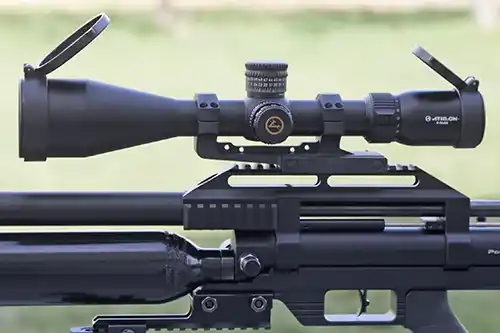
The Athlon Heras SPR 6-24×56 APLR9 FFP IR MOA combines a first focal plane illuminated reticle, locking windage, a zero stop, and parallax adjustment down to 10 yards. This review covers its glass, tracking, reticle, and close-range performance on my friend Austin’s FX Maverick precision air rifle. Athlon still lists this exact configuration as current, with a $699.99 MSRP. The FX is available in .177, .22, .25, and .30 calibers, and it gave us an accurate platform for testing the scope in a large backyard.
Athlon Heras SPR 6-24×56 APLR9 FFP IR MOA description and features
Borrowing features from other scopes in the Athlon range, the Heras is intended for rimfire and air rifles. Therefore, it’s got the locking turrets and zero stop, but also parallax adjustment down to a mere ten yards. Breaking down the name, it offers a 6-24x magnification range, with a bright 56mm objective. And APLR9 is their designation for the reticle, with IR denoting it has an illuminated reticle. Although available in either FFP or SFP (first or second focal plane), this one is FFP. Finally, this is the MOA version, although they offer it in MILs as well.
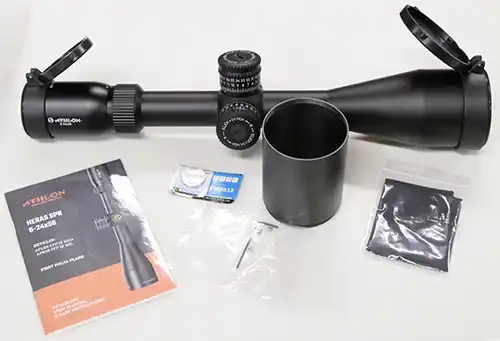
Mounting this scope will require either rings or a one-piece mount in 30mm. Generous eye relief of 3.6″ is plenty for the low-recoil firearms it’s designed for. Depending on magnification, the field of view varies from 19.9 down to 5.1 feet at 100 yards. As already mentioned, parallax can be set all the way down to ten yards. Turret adjustments are 0.25 MOA per click. Overall length is 14.4 inches, and total weight is 32.3 ounces. The packaging includes the scope, caps, shade, battery, lens cloth, manual, and wrench for the zero stop.
First impressions
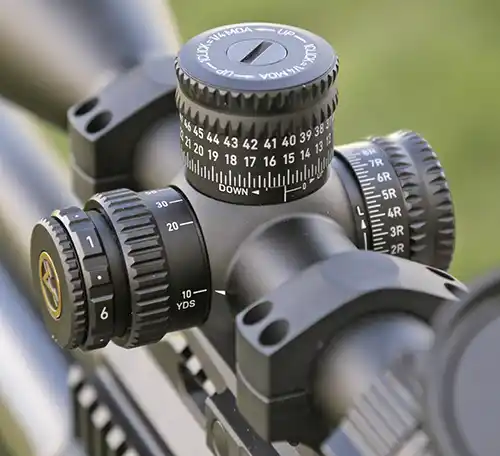
While the numbers say a lot, so do first impressions. Handling the Heras SPR 6-24×56 APLR9 FFP IR MOA out of the box provides a feeling of overall quality. The scope weighs over two pounds, a nod to its very robust construction. Engraved numbers on the turrets are easy to read, and they also have a nice tactile click. Changing magnification is smooth and damped. Adjusting parallax is easy as well, and the numbers are readily legible. My only concern was the illumination ring is so close to the parallax. Turns out that I didn’t need to worry about grabbing that instead of the parallax.
Mounting the Heras SPR 6-24×56 APLR9 FFP IR MOA
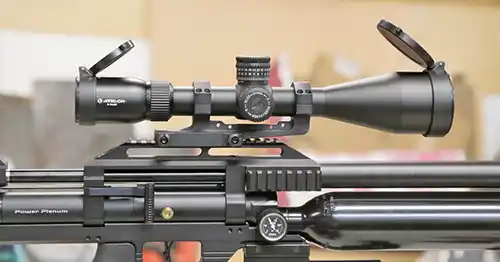
Although Athlon offers some excellent rings, we chose a one-piece mount instead. Even though the FX Maverick has 20 MOA built-in, the mount we used offers another 20 MOA. If 40 MOA seems extreme, keep in mind that pellet velocity is generally around 850 fps. So they run out of steam quickly, and drop faster, even over shorter distances. Austin’s backyard range maxes out at 50 yards, but he can easily stretch it out to 100 at some public shooting ranges. Using the same basic process covered in my scope mounting guide, it only took a few minutes to install the base, adjust the scope for proper eye relief, level it, and torque everything to the correct specifications. A quick laser zero, and we were ready to hit the (backyard) range.
The “Range”
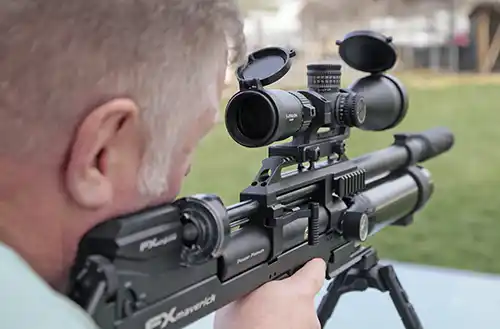
One of the big advantages of air rifles is that they are fairly quiet, and although powerful enough for small game, they can be adjusted down in power too. So in some locations, it’s possible to shoot in a large yard without disturbing or endangering neighbors. Many precision air rifles also use integrated or removable moderators, which helps keep backyard testing quiet. But back to the “range”: for lazy shooting, there is a table set up at 35 yards. Or we can shoot prone at 50 yards. At 35 yards, most rounds are touching. Out at 50, half-inch groups are fairly common. This makes for something like a suppressed rimfire test, without a stamp or the questionable legalities of shooting in a rural-ish neighborhood.
Turrets and tracking
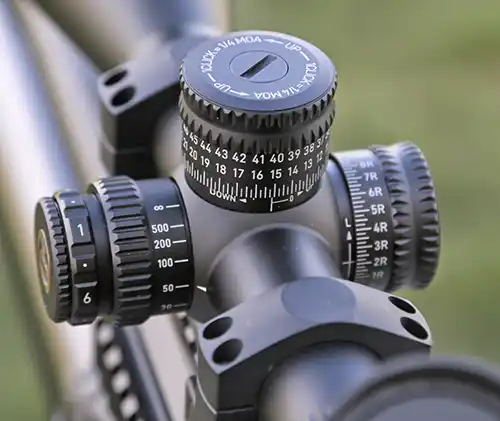
Athlon offers some handy features on the turrets. Preventing bumps to the windage is important for run and gun-style NRL22 shooting. So it’s got locking windage, and the turret has to be pulled out a bit for adjustment. On the elevation turret, there’s a zero stop. Once set, it allows for a quick and easy return to zero, which is also invaluable for engaging targets at varied distances.
For testing the turrets, we did a standard box test. After confirming zero, we dialed in 8 clicks of windage to the right, and fired. Point of impact was one inch to the right of point of aim. Then we dropped 8 clicks of elevation and got the same result. Eight more clicks of windage to the left this time, and things were still looking good. Finally, 8 clicks up brought us back to the starting point. It should also be noted that the turrets have a nice click – neither too hard, too soft, or too mushy. They are positive and offer both tactile and audible feedback. The clicks were also very easy to hear, as no hearing protection is required with this moderated air rifle.
Parallax adjustment
When shooting powerful centerfire cartridges, adjustable parallax correction is helpful for critical accuracy. It’s just as important for rimfire and air rifles, yet also for a slightly different reason. Given the nominal energy of these smaller rounds, being able to quickly determine the distance to the target is key. Whether adjusting the elevation, or just using the reticle’s holdovers, knowing how far the target is allows for easier drop compensation. And the Heras was dead-on when it comes to distance. This makes shooting faster and more intuitive. And check out the photo below – it does indeed focus down to 10 yards.
APLR9 illuminated reticle
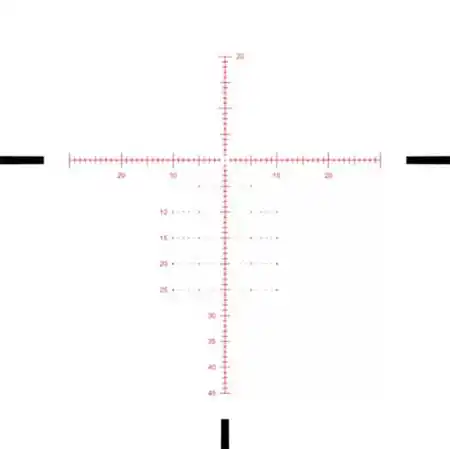
This is another area where the Heras SPR 6-24×56 APLR9 FFP IR MOA excels. The reticle itself has a tiny 0.3 MOA dot in the center, rather than crosshairs. Providing an unobstructed view of the target makes for fast acquisition. Combined with the vertical and horizontal 1 MOA hash marks, holdovers are easy to use. There are indicators every 5 MOA in all four directions, and the manual gives an excellent explanation of how to use them for determining distance as well as holdovers. Illumination across a large dynamic range allows the reticle be seen in bright sunlight all the way down to very low light levels. This isn’t a feature I would use much, but it’s nice to have.
Glass quality
As a photographer, I place a lot of value on good glass. And here is another area where the Heras does well. Image quality is great at lower magnifications, and even at 24x, holds up well enough. There is some chromatic aberration, but it’s nicely controlled. While it might not be acceptable for a photographic lens, it does not detract from the shooting experience. “Good enough” isn’t a negative either. All lenses suffer at higher magnification, and Athlon has done a good job of finding that balance between price and quality. Athlon currently lists this exact APLR9 FFP IR MOA configuration at a $699.99 MSRP. Better glass is available, but moving up from this level generally costs considerably more.
Before buying, compare current price and availability.
- Check the Athlon Heras SPR 6-24×56 APLR9 on Amazon
- Compare current Athlon scope pricing at Brownells
- View the official Athlon specifications
Conclusion
As a kid, the BB and pellet rifles we had were mostly “minute of empty soda can” accurate. As adults, we now have access to air rifles with some impressive features, and very high levels of accuracy. The Heras SPR 6-24×56 allows us to utilize these rifles to their fullest potential, whether making tiny holes in paper, or hunting small game. It’s a nice combination of features found on more expensive scopes, all backed by one of the best warranties in the business. If you’ve got a precision air rifle or rimfire rifle, this is a scope that deserves some consideration.
As always, we’d like to thank Athlon for providing the Heras SPR 6-24×56 APLR9 FFP IR MOA scope for our testing and evaluation.
And a shoutout to Utah Airguns, which is an excellent source of precision airguns and accessories. They carry both FX air rifles and the Athlon scope used in this review.